

:root {
–bl-bg: #060913;
–bl-card: #0c1424;
–bl-inner: #070c18;
–bl-accent: #eab308;
–bl-accent-hover: #facc15;
–bl-text: #ffffff;
–bl-muted: #94a3b8;
–bl-border: rgba(255, 255, 255, 0.08);
}
.bl-pure-wrap {
width: 100%;
background: var(–bl-bg);
color: var(–bl-text);
font-family: -apple-system, BlinkMacSystemFont, “Segoe UI”, Roboto, sans-serif;
padding: 30px 20px 70px 20px;
box-sizing: border-box;
}
.bl-pure-container {
max-width: 1000px;
margin: 0 auto;
}
.bl-hero-card {
background: var(–bl-card);
border: 1px solid var(–bl-border);
border-radius: 16px;
padding: 36px;
margin-bottom: 35px;
box-shadow: 0 10px 30px rgba(0, 0, 0, 0.4);
}
.bl-hero-img {
width: 100%;
max-height: 420px;
border-radius: 12px;
overflow: hidden;
margin-bottom: 28px;
border: 1px solid var(–bl-border);
}
.bl-hero-img img {
width: 100%;
height: 100%;
object-fit: cover;
display: block;
}
.bl-h1 {
font-size: 32px;
font-weight: 800;
margin: 0 0 16px 0;
color: #ffffff;
line-height: 1.3;
}
.bl-meta-bar {
display: flex;
gap: 16px;
font-size: 13.5px;
color: var(–bl-muted);
margin-bottom: 24px;
border-bottom: 1px solid var(–bl-border);
padding-bottom: 14px;
}
.bl-p-lead {
color: var(–bl-muted);
font-size: 16px;
line-height: 1.85;
margin-bottom: 22px;
}
.bl-p-lead a {
color: var(–bl-accent);
text-decoration: underline;
}
.bl-callout {
background: var(–bl-inner);
border: 1px solid var(–bl-border);
border-left: 4px solid var(–bl-accent);
padding: 20px 24px;
border-radius: 8px;
margin: 28px 0;
}
.bl-callout h4 {
color: #ffffff;
margin: 0 0 8px 0;
font-size: 16px;
}
.bl-callout p {
color: var(–bl-muted);
margin: 0;
font-size: 14.5px;
line-height: 1.6;
}
.bl-cards-grid {
display: grid;
grid-template-columns: repeat(auto-fit, minmax(260px, 1fr));
gap: 20px;
margin: 30px 0;
}
.bl-card-item {
background: var(–bl-inner);
border: 1px solid var(–bl-border);
border-radius: 12px;
padding: 22px;
border-top: 3px solid var(–bl-accent);
}
.bl-card-item h3 {
font-size: 17.5px;
font-weight: 700;
color: #ffffff;
margin: 0 0 10px 0;
}
.bl-card-item p {
color: var(–bl-muted);
font-size: 14px;
line-height: 1.6;
margin: 0;
}
.bl-pure-cta {
background: linear-gradient(135deg, #0c1322 0%, #17243e 100%);
border: 1px solid var(–bl-accent);
border-radius: 14px;
padding: 40px 24px;
text-align: center;
box-shadow: 0 15px 35px rgba(0,0,0,0.6);
}
.bl-pure-btn {
display: inline-block;
background: var(–bl-accent);
color: #060913 !important;
font-weight: 800;
font-size: 15px;
padding: 14px 32px;
border-radius: 8px;
text-decoration: none;
margin-top: 18px;
transition: background 0.2s ease;
}
.bl-pure-btn:hover {
background: var(–bl-accent-hover);
}
@media(max-width:768px){
.bl-h1 { font-size: 26px; }
.bl-hero-card { padding: 22px; }
}
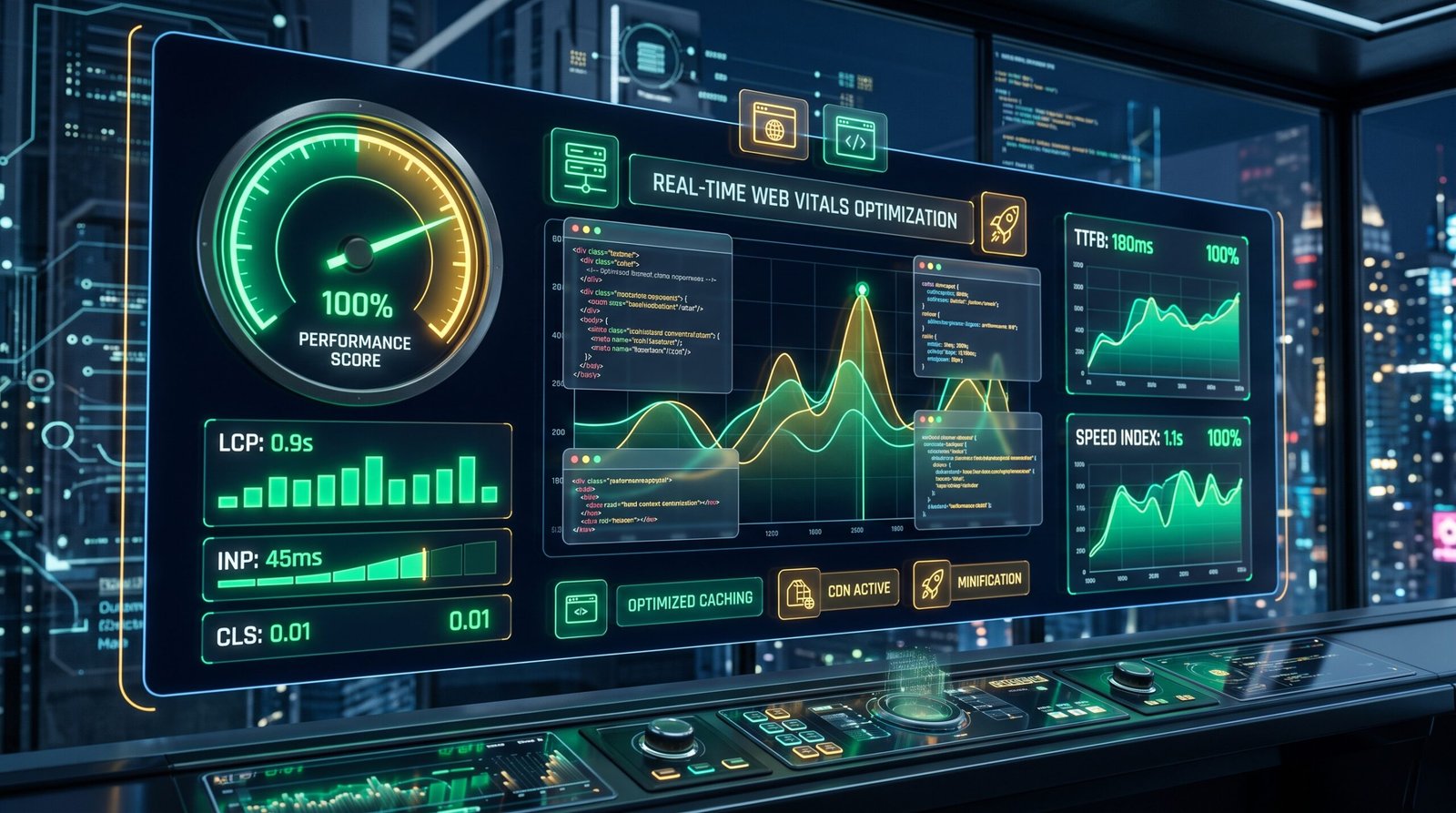
The Definitive Guide to Optimizing Core Web Vitals for Search Visibility
Google’s page experience ranking signals directly dictate search engine visibility and conversion rates. To outrank competitors across organic search, mastering Core Web Vitals has become mandatory for every enterprise platform. These performance metrics evaluate real-world user interaction, asset loading efficiency, and visual stability under diverse network conditions.
Following established web performance criteria documented on Google Web Dev Vitals and technical specifications from MDN Web Docs, this guide outlines the structural architecture adjustments required to score straight green across all technical audits.
⚡ Key Takeaway: The Three Pillars of Core Web Vitals
Google evaluates Largest Contentful Paint (LCP) for perceived loading speed, Interaction to Next Paint (INP) for responsive user interactivity, and Cumulative Layout Shift (CLS) for layout stability.
Largest Contentful Paint
Measures perceived loading speed. Ideal performance requires the main viewport content block to render in under 2.5 seconds.
Interaction to Next Paint
Measures user interaction responsiveness. Demands click and tap execution latencies to remain under 200 milliseconds.
Cumulative Layout Shift
Measures visual layout stability. Requires zero unexpected content jumping, with target scores remaining below 0.1.
Understanding the Largest Contentful Paint (LCP) Metric
Largest Contentful Paint measures how quickly the primary visible content block—usually a hero banner, featured image, or main heading—renders on the user screen. To achieve optimal Core Web Vitals scores, LCP must occur within 2.5 seconds of the initial page request.
Slow server response times (TTFB), client-side render-blocking CSS stylesheets, and unoptimized heavy image assets are the main causes of poor LCP scores. Our engineering practices implement preloading headers (`<link rel=”preload”>`), WebP image compression, and edge caching via CDN to eliminate rendering latency.
Remediating Interaction to Next Paint (INP) Issues
Replacing First Input Delay (FID), Interaction to Next Paint (INP) evaluates overall page responsiveness throughout a user’s entire browsing session. When heavy JavaScript loops tie up the browser’s main thread, user clicks and mobile taps experience laggy input delays.
To sustain excellent Core Web Vitals performance, developers must break up long JavaScript tasks into smaller asynchronous chunks (`requestIdleCallback`), defer non-essential third-party analytics scripts, and avoid executing bulky frameworks on simple content pages.
Eliminating Cumulative Layout Shift (CLS)
Few things frustrate online users more than clicking a link only for the page content to shift unexpectedly. Cumulative Layout Shift occurs when images, dynamic ad banners, or web fonts load without predefined dimensional aspect ratios.
By explicitly defining width and height attributes on all media elements and utilizing font-display swap with fallback matching, our specialized Web Development and Website Maintenance protocols lock the DOM tree into place, preventing layout shifts entirely.
Enterprise Architecture Strategies for Core Web Vitals
Achieving 100% compliance across Core Web Vitals is an ongoing engineering commitment. Server-side caching tools like Redis, automated code tree-shaking, and database query optimizations ensure that pages load with minimal CPU execution overhead.
Modern digital systems require unified technical planning across all functional layers. We ensure your authentication routines, third-party webhook integrations, and client reporting pipelines communicate seamlessly through secure REST protocols. This disciplined engineering workflow eliminates legacy technical debt and provides your team with reliable operational tools.
Our multi-disciplinary engineering team conducts rigorous audits to identify performance bottlenecks before deploying updates to live environments. This rigorous methodology guarantees that your web presence consistently achieves top-tier performance scores and provides frictionless interactions for your users.
Continuous Performance Monitoring and Proactive Maintenance
Maintaining high search engine visibility and user satisfaction requires ongoing attention to technical metrics. Our comprehensive technical audit workflows include regular server logs analysis, broken link monitoring, database defragmentation, and automated Core Web Vitals tracking. By catching potential issues before they impact live traffic, we ensure your business maintains continuous uptime, fast loading speeds, and strong organic visibility across competitive search rankings.
Explore our complete catalog of performance solutions on the All Services Hub or review our specialized Technical SEO frameworks to future-proof your digital presence today.
Need Help Optimizing Your Platform’s Core Web Vitals?
Partner with Malik Hammad Digital to achieve sub-second page speeds, perfect audit scores, and dominant search rankings.
Written by Malik Hammadullah
Certified Enterprise WordPress Architect specializing in sub-150ms TTFB Redis caching, server-level WAF defense, and decoupled Next.js systems. Engineering bulletproof digital infrastructure since 2018.
Need This Architecture Implemented in Production?
Get your database bottlenecks, server response time (TTFB), and caching architecture audited with a 100% data-backed video report within 24 hours.