

:root {
–bl-bg: #060913;
–bl-card: #0c1424;
–bl-inner: #070c18;
–bl-accent: #eab308;
–bl-accent-hover: #facc15;
–bl-text: #ffffff;
–bl-muted: #94a3b8;
–bl-border: rgba(255, 255, 255, 0.08);
}
.navigation.post-navigation,
.post-navigation,
#comments,
.comment-respond,
.comments-area {
display: none !important;
}
.bl-pure-wrap {
width: 100%;
background: var(–bl-bg);
color: var(–bl-text);
font-family: -apple-system, BlinkMacSystemFont, “Segoe UI”, Roboto, sans-serif;
padding: 30px 20px 70px 20px;
box-sizing: border-box;
}
.bl-pure-container {
max-width: 1000px;
margin: 0 auto;
}
.bl-hero-card {
background: var(–bl-card);
border: 1px solid var(–bl-border);
border-radius: 16px;
padding: 36px;
margin-bottom: 35px;
box-shadow: 0 10px 30px rgba(0, 0, 0, 0.4);
}
.bl-hero-img {
width: 100%;
max-height: 420px;
border-radius: 12px;
overflow: hidden;
margin-bottom: 28px;
border: 1px solid var(–bl-border);
}
.bl-hero-img img {
width: 100%;
height: 100%;
object-fit: cover;
display: block;
}
.bl-body-img {
width: 100%;
max-height: 380px;
border-radius: 12px;
overflow: hidden;
margin: 30px 0 24px 0;
border: 1px solid var(–bl-border);
}
.bl-body-img img {
width: 100%;
height: 100%;
object-fit: cover;
display: block;
}
.bl-h1 {
font-size: 32px;
font-weight: 800;
margin: 0 0 16px 0;
color: #ffffff;
line-height: 1.3;
}
.bl-meta-bar {
display: flex;
gap: 16px;
font-size: 13.5px;
color: var(–bl-muted);
margin-bottom: 24px;
border-bottom: 1px solid var(–bl-border);
padding-bottom: 14px;
}
.bl-p-lead {
color: var(–bl-muted);
font-size: 16px;
line-height: 1.85;
margin-bottom: 22px;
}
.bl-p-lead a {
color: var(–bl-accent);
text-decoration: underline;
}
.bl-callout {
background: var(–bl-inner);
border: 1px solid var(–bl-border);
border-left: 4px solid var(–bl-accent);
padding: 20px 24px;
border-radius: 8px;
margin: 28px 0;
}
.bl-callout h4 {
color: #ffffff;
margin: 0 0 8px 0;
font-size: 16px;
}
.bl-callout p {
color: var(–bl-muted);
margin: 0;
font-size: 14.5px;
line-height: 1.6;
}
.bl-cards-grid {
display: grid;
grid-template-columns: repeat(auto-fit, minmax(260px, 1fr));
gap: 20px;
margin: 30px 0;
}
.bl-card-item {
background: var(–bl-inner);
border: 1px solid var(–bl-border);
border-radius: 12px;
padding: 22px;
border-top: 3px solid var(–bl-accent);
}
.bl-card-item h3 {
font-size: 17.5px;
font-weight: 700;
color: #ffffff;
margin: 0 0 10px 0;
}
.bl-card-item p {
color: var(–bl-muted);
font-size: 14px;
line-height: 1.6;
margin: 0;
}
.bl-pure-cta {
background: linear-gradient(135deg, #0c1322 0%, #17243e 100%);
border: 1px solid var(–bl-accent);
border-radius: 14px;
padding: 40px 24px;
text-align: center;
box-shadow: 0 15px 35px rgba(0,0,0,0.6);
}
.bl-pure-btn {
display: inline-block;
background: var(–bl-accent);
color: #060913 !important;
font-weight: 800;
font-size: 15px;
padding: 14px 32px;
border-radius: 8px;
text-decoration: none;
margin-top: 18px;
transition: background 0.2s ease;
}
.bl-pure-btn:hover {
background: var(–bl-accent-hover);
}
@media(max-width:768px){
.bl-h1 { font-size: 26px; }
.bl-hero-card { padding: 22px; }
}
Modern Full-Stack Web Development Architectures for Scalability
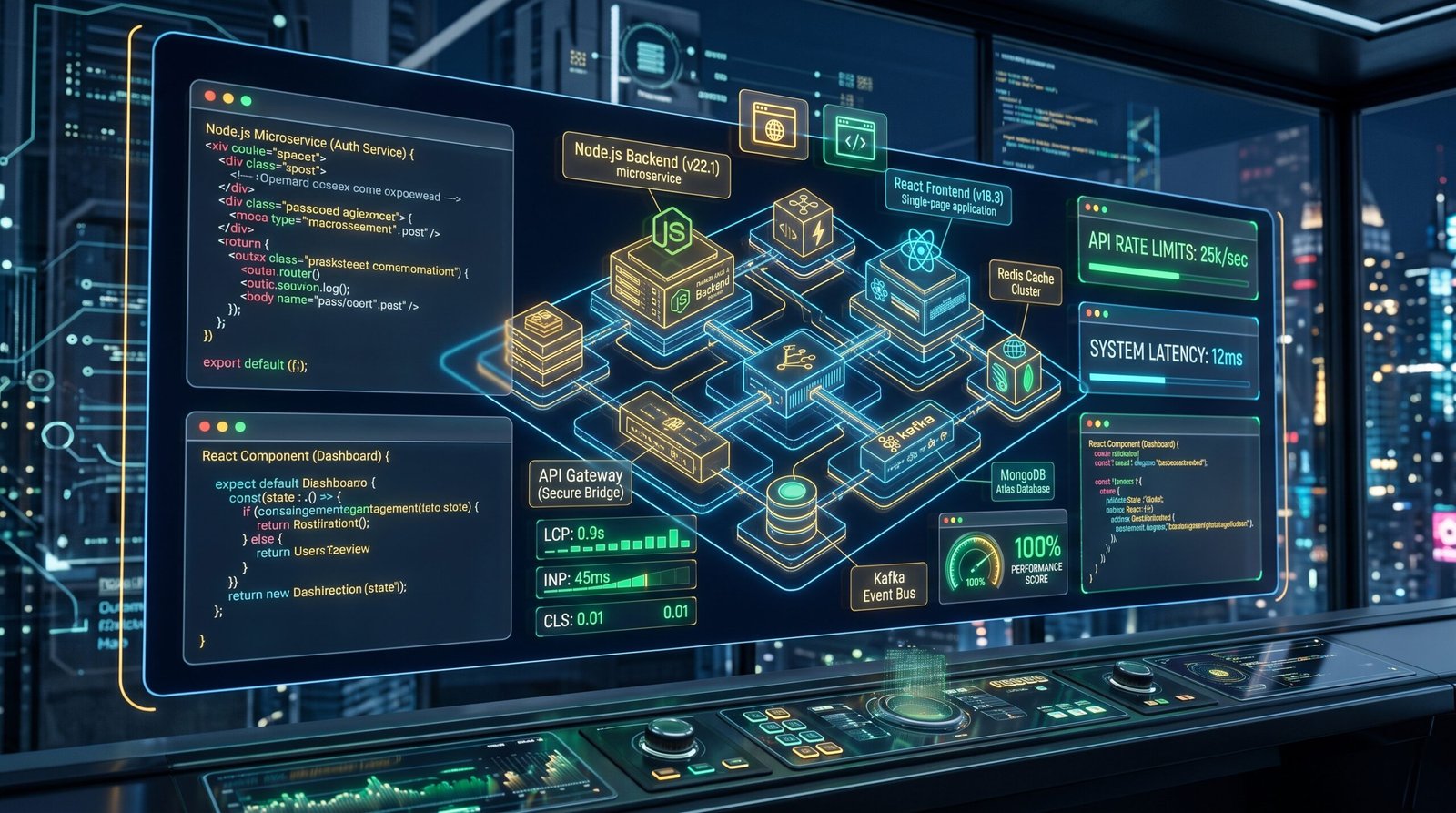
Building scalable digital applications requires far more than assembling visual components on a page. Modern enterprise systems demand an end-to-end engineering discipline across the entire stack. When organizations transition from brittle monolithic themes to custom Full-Stack Web Development, they establish modular software foundations capable of processing thousands of concurrent user interactions without latency degradation.
Following established software engineering benchmarks documented on MDN Web Docs Frameworks and performance standards from Google Web Dev, our technical architecture isolates front-end presentation layers from heavy backend computation, ensuring sub-second response times and high server throughput.
⚡ Key Takeaway: Full-Stack Architecture Modularity
Decoupling monolithic software into lightweight client-side interfaces and asynchronous API services eliminates single points of failure while lowering compute costs under peak traffic.
Decoupled API Gateways
Structured REST and GraphQL endpoints that distribute data payloads efficiently without binding UI templates to database logic.
Relational Schema Tuning
Custom indexed MySQL and PostgreSQL tables engineered to execute complex relational queries in sub-50ms execution cycles.
In-Memory Data Caching
Redis object caching layers that intercept repeated queries and deliver instant pre-computed datasets to client threads.
The Evolution of Monoliths to Decoupled Full-Stack Web Development
Traditional all-in-one content management themes couple database queries directly with HTML presentation logic. Under sudden traffic spikes, single unoptimized database queries lock entire server worker processes. In modern Full-Stack Web Development, presentation logic is rendered through clean, compiled front-end bundles that interact with microservices solely through asynchronous webhooks.
This structural separation ensures that an isolated surge in user checkouts or content filtering never degrades the availability of your primary web application. Review our custom engineering services on the All Services Hub or explore our dedicated Web Development and WordPress Development frameworks to examine real-world decoupled implementations.
Database Scaling and Query Optimization in Full-Stack Web Development
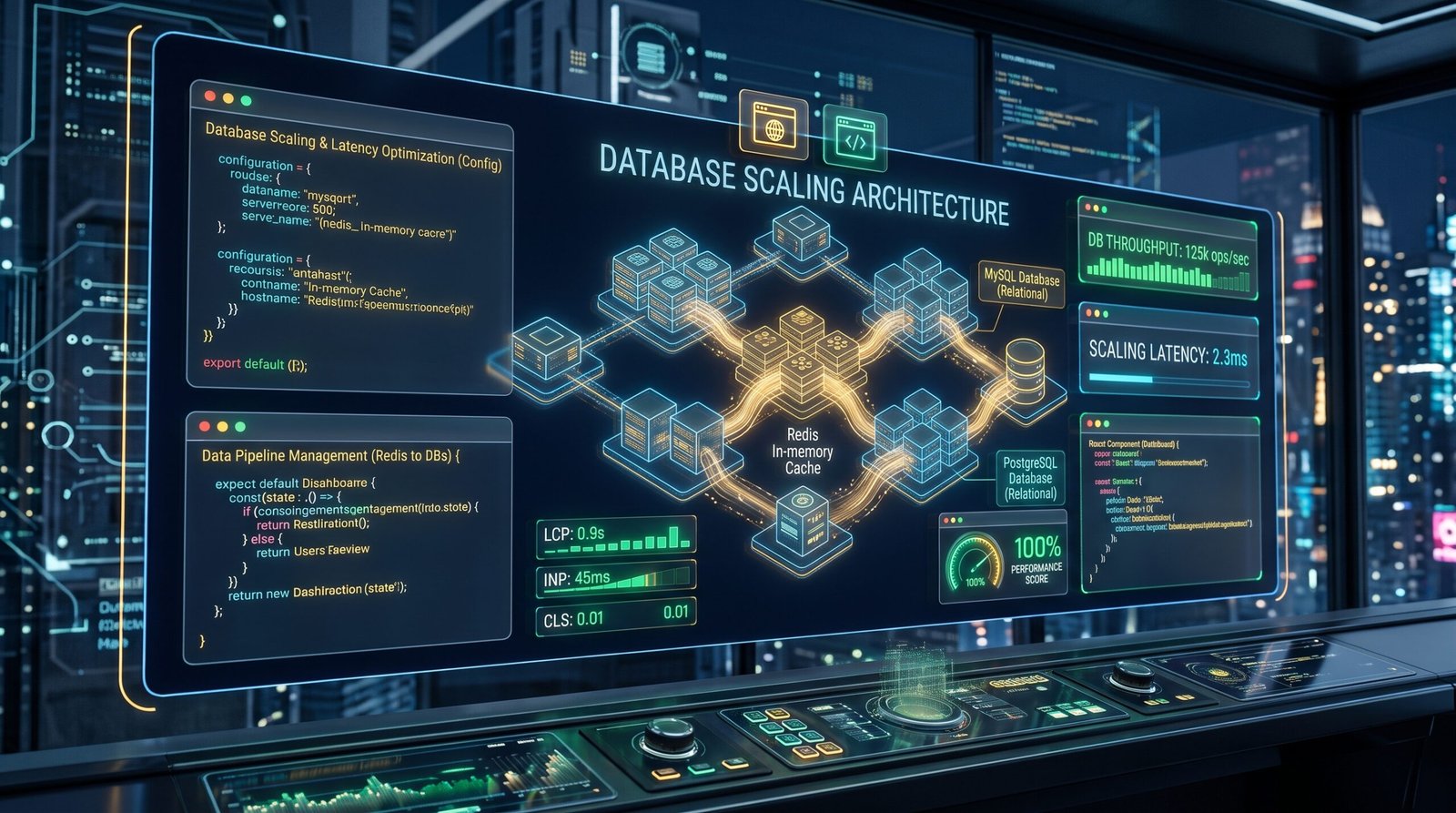
Database throughput forms the primary bottleneck in large-scale applications. When thousands of users filter products or request authenticated profiles simultaneously, unindexed meta tables trigger catastrophic CPU spikes. Enterprise Full-Stack Web Development incorporates composite B-tree indexing, query partitioning, and connection pooling to ensure relational lookups execute instantly.
Modern digital systems require unified technical planning across all functional layers. We ensure your authentication routines, third-party webhook integrations, and client reporting pipelines communicate seamlessly through secure REST protocols. This disciplined engineering workflow eliminates legacy technical debt and provides your team with reliable operational tools.
Headless Pipelines and API-Driven Frontends
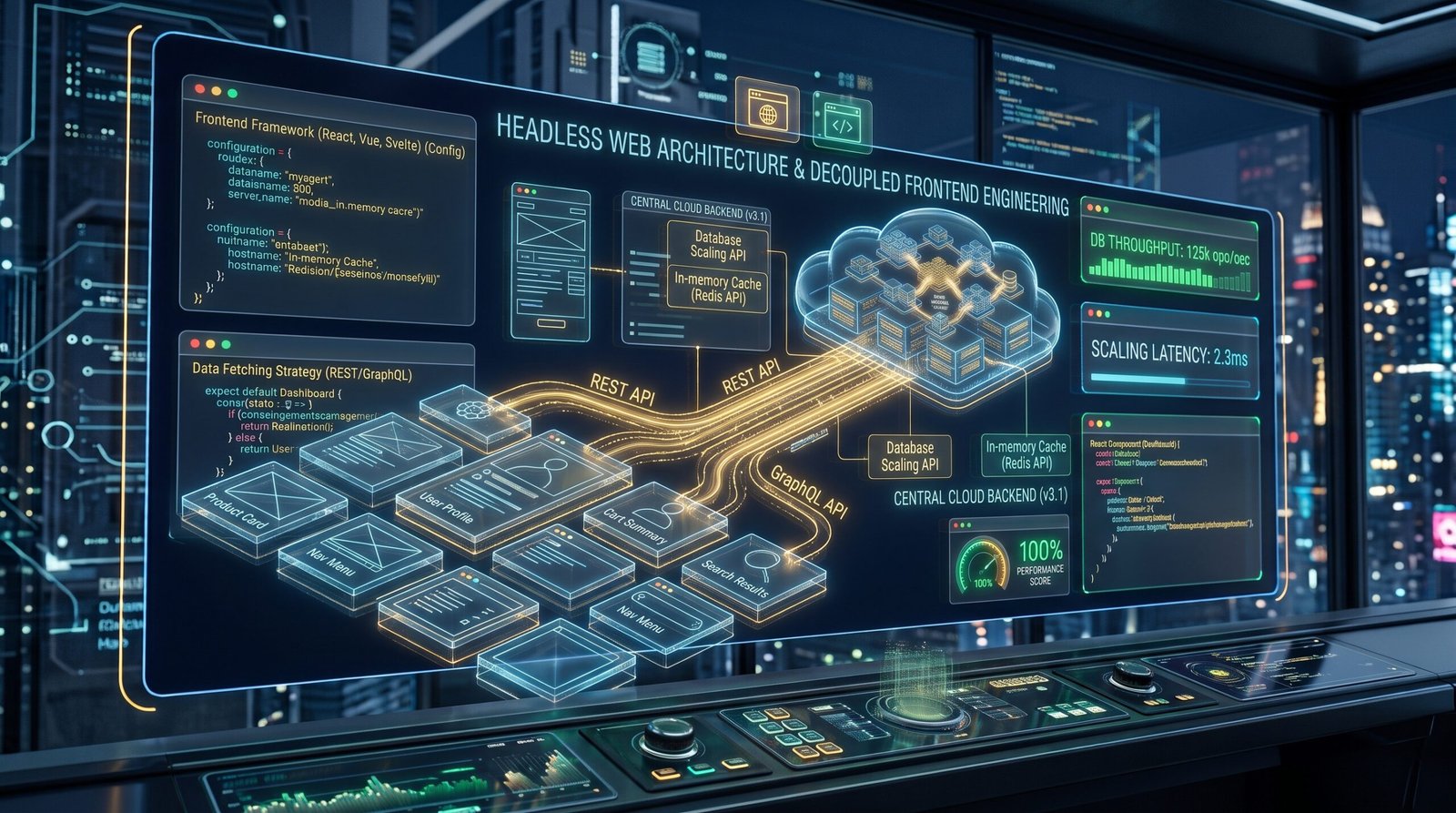
Headless systems empower engineering teams to deliver native-feeling application experiences across desktop browsers and mobile devices. By integrating lightweight client interfaces with headless CMS backends, enterprise Full-Stack Web Development achieves near-zero Time to First Byte (TTFB) while enabling continuous deployment without downtime risks.
Our multi-disciplinary engineering team conducts rigorous audits to identify performance bottlenecks before deploying updates to live environments. This rigorous methodology guarantees that your web presence consistently achieves top-tier performance scores and provides frictionless interactions for your users.
Continuous Security Hardening and Token Authentication
Enterprise architectures demand robust defenses against automated scraping, cross-site request forgery (CSRF), and credential stuffing. In our dedicated Full-Stack Web Development workflows, we implement short-lived JSON Web Tokens (JWT), strict rate limiting on all public API endpoints, and Content Security Policies (CSP) that neutralize malicious script execution.
Future-Proofing Your Platform with Full-Stack Web Development
Investing in a scalable web architecture pays substantial dividends in organic visibility, user retention, and infrastructure cost reduction. When your digital platform is engineered with clean modular components and optimized database schemas, expanding new feature sets becomes swift, predictable, and risk-free.
Explore related architecture strategies across our E-Commerce Stores and Website Maintenance guides, or connect with our engineering team to construct an enterprise-grade web application today.
Ready to Build Custom Full-Stack Web Development Architecture?
Partner with Malik Hammad Digital to engineer fast, scalable, and resilient full-stack applications tailored for enterprise performance.
Written by Malik Hammadullah
Certified Enterprise WordPress Architect specializing in sub-150ms TTFB Redis caching, server-level WAF defense, and decoupled Next.js systems. Engineering bulletproof digital infrastructure since 2018.
Need This Architecture Implemented in Production?
Get your database bottlenecks, server response time (TTFB), and caching architecture audited with a 100% data-backed video report within 24 hours.